
Module 2.3
Explain influences and outcomes of agents of change on forests and landscapes
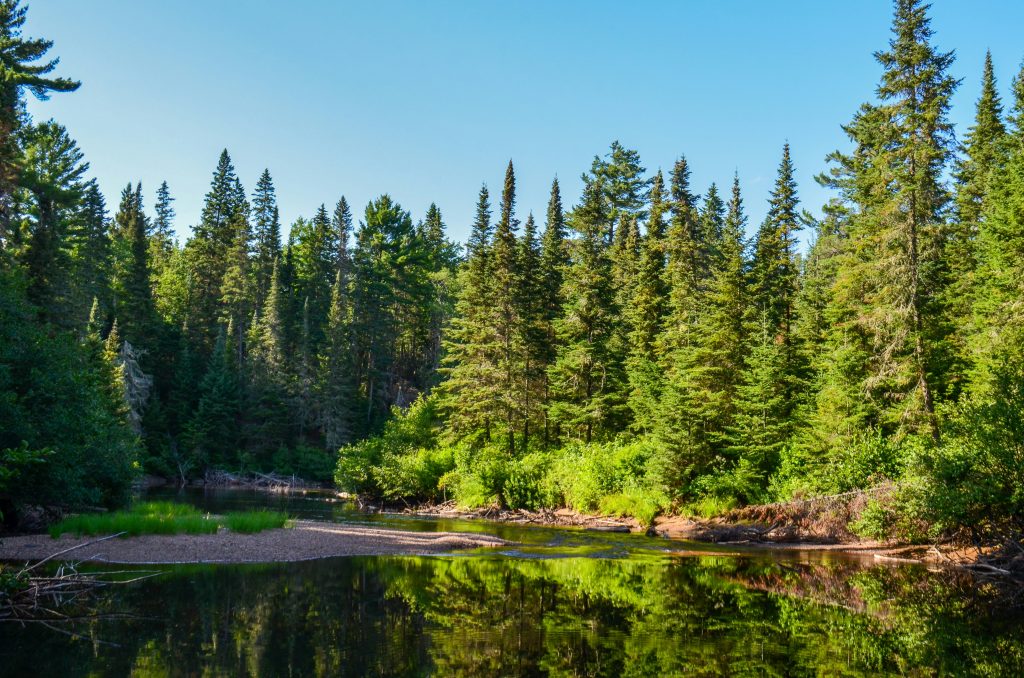
Overall objectives of Module 2.3 are to enhance students’ knowledge and comprehension of influences and outcomes of agents of change on forest ecosystems at forest stand and landscape scales. Key topics include the impacts of forest insects and disease, integrated pest management concepts, natural disturbances from forest fire and weather events, impacts of climate change, and the myriad influences of human impacts on the ecology of forests and forested landscapes.
Module Objectives
- Recognize and explain the dynamics of and roles of insects and disease on forests and landscapes;
- Explain how integrated pest management can modify change on forests and landscapes;
- Explain the role of fire and weather factors on forests and landscapes;
- Recognize the impact of changing climate on forests and landscapes;
- Discuss the influence of human activities on forests and landscapes.
Module Schedule
This course involves a combination of recorded lectures, readings, assignments and participation in semi-synchronous online discussion forums and synchronous tutorials with instructors and other participants over an 8-week period.
See course content below to get started!
Course Content
Getting Started
Getting Started
-

Getting Started
Welcome to Module 2.3
Week 1
Week 1
-

Introductory Lectures
Introductory core lecture using knowledge elements 2.3.1, 2.3.2, 2.3.4, and 2.3.5 as the organizational framework to introduce key concepts and related content.
-
Core Lecture 1: Ontario’s Far North
Ontario’s Far North
-
Core Lecture 2: Water and other abiotic factors
Conifer vs. hardwood water transport, flood tolerance, wind, temperature, shade, drought tolerance, and other factors that influence the form and functional biology of trees, stands, and forests.
-
Supplementary Lecture (not mandatory)
Human impacts on the ecology of managed forests managed forest landscapes - Biology vs. Forestry Biology, stands as operational units, Normal forest concept, silvicultural intensity continuum (technological forestry vs. ecological forestry; domesticated vs. regulated vs. exploited forest), silviculture defined, coppice, clearcutting, clearcut silviculture, thinning, shelterwood silviculture, selection silviiculture
-

Readings
Description, Classification, and Mapping of Forest Ecosystems
Week 2
Week 2
-
Core Lecture 3: Forest conservation along urban-rural gradients
The human condition, urbanization, history of urban greening, the wildland-to-urban continuum, natural cover conversion, urban forestry, the human dimension, challenges (environmental, species diversity, genetic diversity), peri-urban forests, deforestation, solutions and perspectives
-
Supplementary Lecture (not mandatory)
Coarse woody debris – definitions, CWD as habitat, fungi and associates, Elements and nutrient cycles, CWD in forest management CWD decay dynamics, CWD decay classification , transition matrix models
-
Readings
-

Discussion Forum 2.3a
A good fire?
Week 3
Week 3
-

Online tutorial
The online tutorial will give students the opportunity to connect with their instructors and peers to discuss content to-date, answer questions and foster conversations surrounding course materials, and discuss upcoming assignments.
-

Assignment #1
Describe integrated pest management as it is applied in an Ontario context. Also explain how integrated pest management of the sort can modify the impacts of agents change on forests and landscapes.
Week 4
Week 4
-
Discussion Forum 2.3b
IPM in action?
Week 5
Week 5
-

Submission: Assignment #1
Please submit Assignment #1
-
Assignment #2
Research and report on the present and predicted impacts of a changing climate on Ontario forests over the next 50-100 years.
Week 6
Week 6
-
Proposal Submission: Assignment #2
Please submit your proposal for Assignment #2
Week 7
Week 7
-
Online tutorial
The online tutorial will give students the opportunity to connect with their instructors and peers to discuss content to-date, answer questions and foster conversations surrounding course materials, and discuss upcoming assignments. In this particular tutorial, the majority of time will be allocated towards student presentations.
Week 8
Week 8
-
Submission: Assignment #2
Please submit Assignment #2