
Module 2.1
Describe the components, characteristics, and processes of forest ecosystems and how they interact
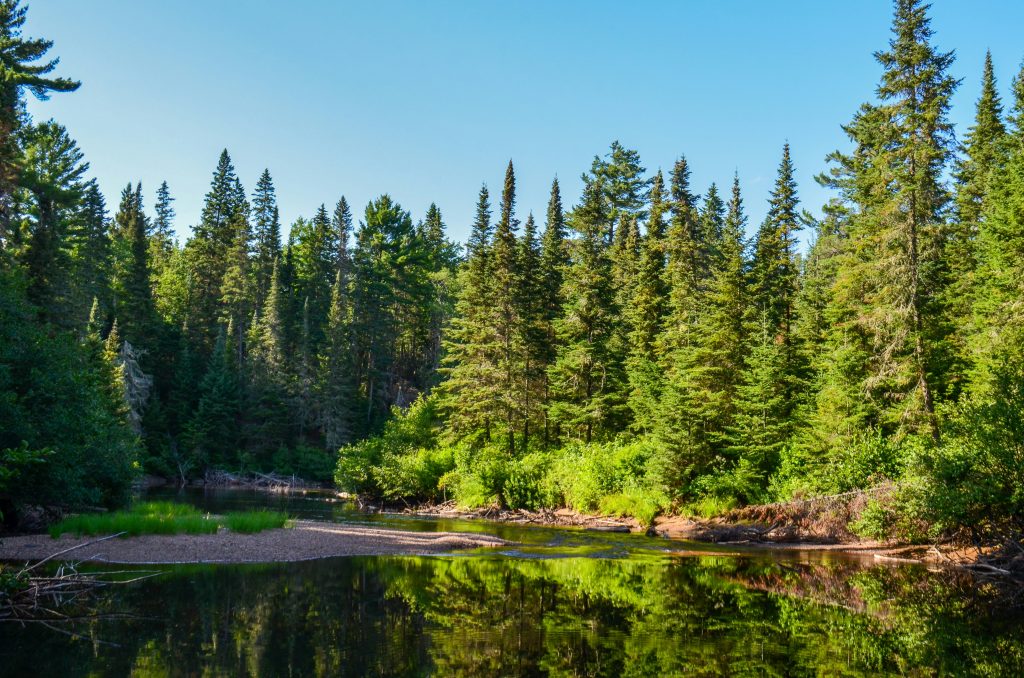
Overall objectives of Module 2.1 are to enhance students’ knowledge and comprehension of forest ecosystems at multiple spatial scales, and to establish an understanding of the relationships that exist between stand-level, forest-level, and landscape-level structure and function with an emphasis on the interaction of biophysical elements such as tree composition, size, and age distributions and the ecosystem services that they provide.
Module Objectives
- Describe living and non-living components;
- Identify and describe major ecosystem conditions, cycles, and processes within forests and landscapes;
- Explain how ecosystem conditions can be characterized across a variety of scales;
- Discuss ecosystem dynamics and ecological sustainability; and
- Explain forest productivity and how it is determined.
Module Schedule
This course involves a combination of recorded lectures, readings, assignments and participation in semi-synchronous online discussion forums and synchronous tutorials with instructors and other participants over an 8-week period.
See course content below to get started!
Course Content
Getting Started
Getting Started
-
Getting Started
Week 1
Week 1
-

Introductory Lecture
Lecture using knowledge elements 2.1.1-2.1.5 as the organizational framework to introduce key concepts and related content
-
Core Lecture 1: Trees and light
Basic biophysics of light and photosynthesis, gap dynamics, early vs. late successional trees [seed types, tree architecture], shade tolerance classes, tree size and successional status relationships at multiple spatial scales.
-
Core Lecture 2: Water and other abiotic factors
Conifer vs. hardwood water transport, flood tolerance, wind, temperature, shade, drought tolerance, and other factors that influence the form and functional biology of trees, stands, and forests.
-

Readings
Description, Classification, and Mapping of Forest Ecosystems
Week 2
Week 2
-
Core Lecture 3: Hierarchical Organization – Biology vs. Forestry Biology
Stands as operational units, Normal forest concept, Silvicultural intensity continuum: technological forestry vs. ecological forestry; domesticated vs. regulated vs. exploited forest.
-
Supplementary Lectures (not mandatory)
Forest conservation along urban-rural gradients
-
Reading
-

Discussion Forum 2.1 a
Landscape ecology concepts – landscape structure and maintenance
Week 3
Week 3
-

Online tutorial
The online tutorial will give students the opportunity to connect with their instructors and peers to discuss content to-date, answer questions and foster conversations surrounding course materials, and discuss upcoming assignments.
-

Assignment #1
List and describe common forest ecosystem characteristics at the scale of forested landscapes, forests, and forest stands.
Week 4
Week 4
-
Discussion Forum 2.1b
Map scale questions
Week 5
Week 5
-

Assignment #1 Submission
Please submit Assignment #1
-
Assignment #2
Discuss ecosystem dynamics and ecological sustainability of one of Ontario’s three forest regions.
Week 6
Week 6
-
Assignment #2 Proposal Submission
Please submit your proposal for Assignment #2
Week 7
Week 7
-
Online tutorial
The online tutorial will give students the opportunity to connect with their instructors and peers to discuss content to-date, answer questions and foster conversations surrounding course materials, and discuss upcoming assignments.
Week 8
Week 8
-
Assignment #2 Submission
Please submit Assignment #2